
How a Taiwanese immigrant who once earned less than $3 an hour built a $5 trillion empire — and what it teaches us about building real, lasting wealth
If you’ve ever felt like your starting point is too small to lead anywhere big, Jensen Huang’s story might just change your mind.
Today, he runs the most valuable company on Earth. But decades before Wall Street learned his name, he was washing dishes for pennies an hour in a small American restaurant. His journey from that kitchen sink to the boardroom of NVIDIA is one of the most powerful reminders that extra income and long-term thinking can completely rewrite a life — no matter where you start.
Let’s break down how he did it, and what you can actually take away from it.
Humble Beginnings: From Taiwan to the American Midwest
Jensen Huang was born in Taiwan in 1963, the son of a chemical engineer and a teacher. As a child, his family moved first to Thailand, then to the United States, where he grew up between Kentucky and Oregon.
There was nothing glamorous about those early years. Like millions of immigrant families, the Huangs worked hard for every dollar — and young Jensen learned early on that opportunity rarely knocks on its own. You have to build it, one small job at a time.
From Engineering Degree to Silicon Valley
Huang earned his degree in electrical engineering from Oregon State University in 1984, then made the move every ambitious tech worker dreams about: Silicon Valley.
He worked at AMD and later at LSI Logic, all while completing a master’s degree at night at Stanford — finishing in 1992. It was during this period that he met Lori Mills, his future wife and lab partner. They’ve now been married for more than three decades.
This part of his story matters more than people realize. Huang didn’t get lucky overnight. He stacked skills, discipline, and a long-term mindset for nearly a decade before his big break ever showed up.
The Company That Was Born at a Diner
In April 1993, Huang met engineers Chris Malachowsky and Curtis Priem at a Denny’s in San Jose, California. Over coffee and pancakes, the three of them sketched out the plan for a company that would eventually be called NVIDIA.
The original idea was simple: build graphics processors for the video game industry. They started with just $40,000 in capital, later raising around $20 million from venture capital investors. For the next two decades, NVIDIA grew steadily in the graphics card market — but it also came dangerously close to going under more than once.
This is the part most success stories skip over: the boring middle. The years of grinding through a market that hadn’t yet made anyone rich.
The AI Boom That Changed Everything
Then came the turning point nobody fully predicted. The same graphics chips built for gaming turned out to be perfect for training artificial intelligence models — and demand for NVIDIA’s technology exploded.
Almost overnight, NVIDIA became essential infrastructure for the entire tech industry, from smartphone makers to generative AI labs. Huang’s personal fortune is now estimated at around $166 billion, with roughly 97% of it tied directly to NVIDIA stock.
That last detail is worth sitting with for a second: his wealth isn’t diversified — it’s concentrated in the business he built. That’s an extremely high-risk, high-reward strategy, and it’s not one most of us should copy directly. If you’re building your own income streams and investments, spreading your risk across different assets is usually the smarter move. We go deeper into exactly how to do that in this guide to building a truly diversified investment portfolio — even if you’re just getting started.
Recognition Beyond the Balance Sheet
Huang’s influence today goes beyond the stock market. He’s a member of the National Academy of Engineering and, in 2026, joined the U.S. presidential council of advisors on science and technology.
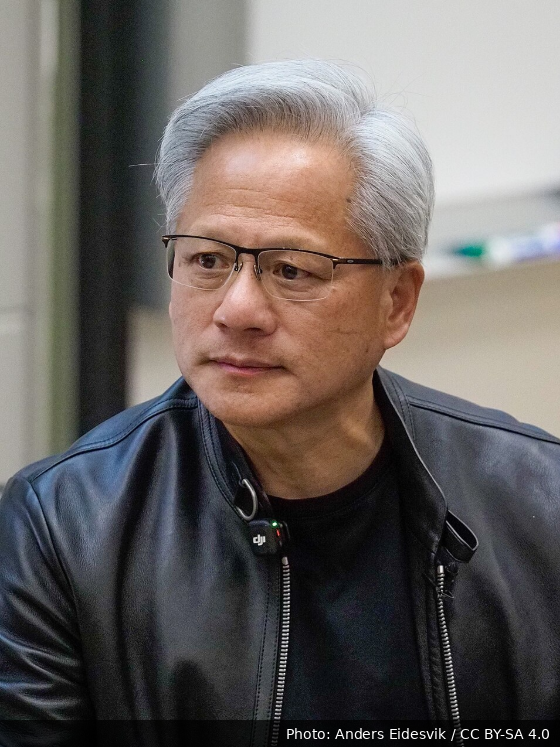
He’s also become something of a pop-culture figure, instantly recognizable for the black leather jacket he wears at nearly every public appearance — now practically part of NVIDIA’s brand identity.
What Jensen Huang’s Story Really Teaches Us About Building Wealth
Strip away the trillion-dollar headlines, and a clear pattern emerges — one that applies just as much to someone building a side hustle from their kitchen table as it does to a Silicon Valley CEO:
- Technical skill is a foundation, not a shortcut. Huang’s years of solid engineering training gave him the judgment to make big strategic bets later on.
- Staying the course pays off. NVIDIA existed for 20 years before the AI wave arrived. He didn’t quit when it was slow — he was still there when it mattered.
- Concentration cuts both ways. Tying your fortune to one asset can create extraordinary upside, but it also means extraordinary risk. Most of us build wealth more safely by diversifying.
None of this requires a Silicon Valley zip code or a Stanford degree. What it does require is the same thing it required of Huang: showing up consistently, learning constantly, and putting your money to work wisely once you start earning more.
If today’s story got you thinking about your own income streams, our Extra Income section is a great place to explore practical ways to start building yours. And if you want more real stories of people who turned small beginnings into something bigger, check out our other Success Stories.
Want to stay on top of how AI and tech leaders are reshaping the economy? Our News section keeps you updated — and if you’re ready to put your money to work the smart way, our Invest Better hub is the perfect next stop.
Source: reporting by Bianca Bezerra Pinto, Exame.

One thought on “From Dishwasher to CEO of the World’s Most Valuable Company: The Jensen Huang Success Story”