
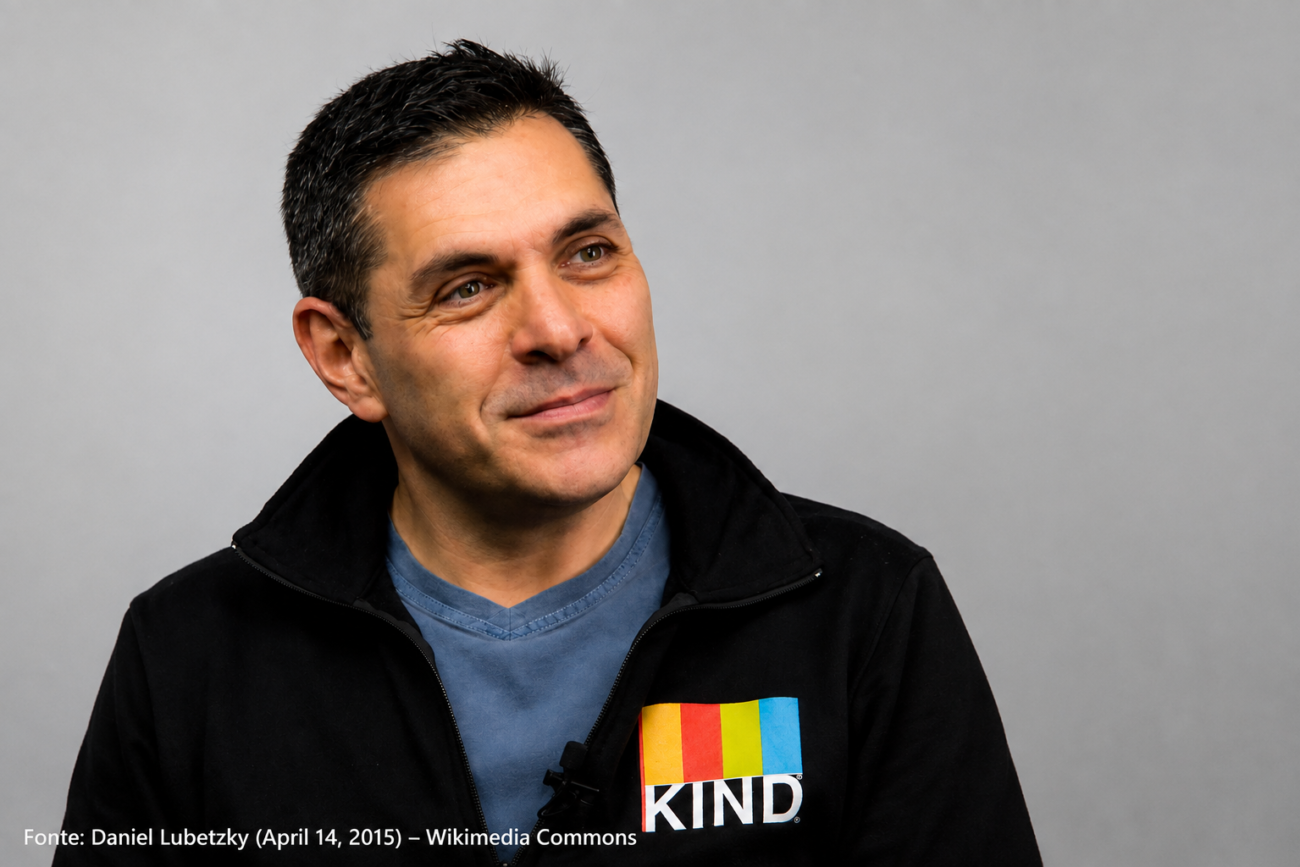
Daniel Lubetzky is having a moment again. In September 2026, the KIND Snacks founder launched Build or Break, a weekly interview podcast where he sits down with entrepreneurs, athletes, and public figures to talk not about their wins, but about the failures that almost broke them.
It is a fitting project for a man whose own path to a multibillion-dollar business was anything but smooth. Before KIND became one of the most recognizable snack brands in America, Lubetzky went through a struggling first company, unsold inventory piling up in his own apartment, and a public fight with federal regulators. His story is less about a single lucky break and more about what happens when a founder refuses to quit after the third, fourth, or fifth setback.
Here is how he built KIND Snacks, what nearly stopped him along the way, and the lessons any entrepreneur can take from his 30-year climb.
Who Is Daniel Lubetzky?
Lubetzky was born in Mexico City to a father who survived the Holocaust. That family history shaped him early. He has said publicly that his father taught him that even in the darkest circumstances, small acts of kindness matter — a lesson that would eventually become the literal name of his company.
He moved to San Antonio, Texas, as a teenager, graduated from Trinity University, and went on to earn a law degree from Stanford. Lubetzky expected to practice law and eventually move into diplomacy focused on the Middle East. Instead, he found his way into business almost by accident, through a venture built around food rather than courtrooms.
That detour turned out to define his entire career. Decades later, Lubetzky would describe himself less as a traditional CEO and more as a “social entrepreneur” — someone who measures success by both financial return and real-world impact. It’s a framing that shows up consistently across every company he has since built, from a peace-focused food venture to a snack brand that eventually sold for billions.
The First Business: PeaceWorks
In 1994, shortly after finishing law school, Lubetzky launched his first company, PeaceWorks. The idea was unusual: use commercial partnerships between Israeli, Palestinian, and other Middle Eastern producers to create shared economic interests as a small, practical contribution to regional peace. PeaceWorks sold products like sun-dried tomato spreads made through those cross-border collaborations.
The company never became a major financial success. At one point, Lubetzky was storing thousands of unsold boxes of product in his own small Manhattan apartment. But PeaceWorks taught him two things that would define the rest of his career: that market forces could be used to drive social impact, and that a values-driven mission alone is not enough — the product still has to be genuinely good.
How KIND Snacks Was Born
The idea for KIND came out of a personal frustration. While training for the New York Marathon in the early 2000s, Lubetzky wanted a snack bar that was both filling and made from simple, recognizable ingredients. Most bars on the market at the time were built around processed “paste” fillings. He couldn’t find what he wanted, so he decided to build it himself.
In 2004, he launched KIND with a simple format: transparent packaging that let customers see the whole nuts and fruit inside, and a name with no marketing spin behind it. According to Lubetzky, the goal was a product that was “kind to your body, kind to your taste buds, and kind to the world.”
The bet paid off. KIND tapped into a wave of consumer demand for less processed, more transparent food, at a time when the broader snack bar market was worth roughly $6 billion. Sales grew from a niche health-food item into national distribution, and by 2014 the company was selling more than 458 million bars and granola pouches a year.
The Setback That Almost Derailed Everything
KIND’s growth was not a straight line. Its most serious crisis came in 2015, when the U.S. Food and Drug Administration sent the company a warning letter. The FDA argued that KIND could not legally use the word “healthy” on several of its bars, because their fat content — driven largely by whole almonds — exceeded outdated federal limits, even though nuts were widely recognized by nutritionists as a healthy ingredient.
Lubetzky has since described the moment as devastating. Rather than simply changing the packaging and moving on, he chose to fight the underlying rule. KIND filed a formal petition asking the FDA to update its decades-old definition of “healthy” to reflect current nutrition science, and Lubetzky personally traveled to FDA headquarters to make the case.
The dispute dragged on for more than a year and came with real business risk, including a class-action lawsuit tied to the labeling issue. In May 2016, the FDA reversed itself and allowed KIND to reintroduce the word “healthy” on its packaging and website. The agency also acknowledged that its nutrient labeling rules needed to be modernized. For Lubetzky, the episode became proof that a company could challenge a regulator on principle and still come out with its reputation strengthened rather than damaged.
From Independent Brand to a Multibillion-Dollar Exit
KIND’s next major chapter involved Mars, the global candy and snack giant. Mars first took a minority stake in KIND in 2017, when the company was already valued at more than $4 billion, with Lubetzky remaining the majority shareholder and continuing to run day-to-day operations from KIND’s New York headquarters.
In November 2020, Mars agreed to acquire KIND North America outright in a deal reported to be worth around $5 billion. Lubetzky retained an ongoing financial stake in the combined business and stayed involved in its strategic direction as Executive Chairman, while a significant portion of his personal stake had already been committed to philanthropic causes.
The deal turned Lubetzky into a billionaire, with Forbes estimating his net worth at roughly $2.2 to $2.3 billion in the years following the transaction. In 2023, he added a new public role, joining “Shark Tank” as an investor, taking the seat vacated by Mark Cuban.
KIND Snacks: Key Milestones
| Year | Milestone |
|---|---|
| 1994 | Lubetzky launches his first company, PeaceWorks, focused on cross-border Middle East food ventures |
| 2004 | KIND Snacks launches with transparent packaging and whole-food ingredients |
| 2014 | KIND sells more than 458 million bars and granola pouches in a single year |
| 2015 | FDA warning letter challenges KIND’s use of the word “healthy” |
| 2016 | FDA reverses its decision after KIND’s formal petition |
| 2017 | Mars takes a minority stake in KIND, valuing the company at more than $4 billion |
| 2020 | Mars agrees to acquire KIND North America in a deal reported at roughly $5 billion |
| 2023 | Lubetzky joins “Shark Tank” as an investor, replacing Mark Cuban |
| 2026 | Lubetzky launches the “Build or Break” interview podcast |
What Daniel Lubetzky Did Differently
A few decisions separated Lubetzky’s approach from many consumer-brand founders:
- He treated transparency as a product feature, not a marketing slogan. The see-through KIND wrapper was a direct response to a market full of opaque packaging and long ingredient lists.
- He fought regulatory battles instead of quietly complying. When the FDA challenge came, he could have simply reformulated or relabeled. Instead, he used the moment to push for a policy change that outlasted his own company’s interests.
- He didn’t abandon the mission when the math got hard. PeaceWorks never became a big business, but Lubetzky carried its “not-only-for-profit” philosophy directly into KIND rather than discarding it as a failed experiment.
- He kept building past his first exit. Even after the Mars deal, Lubetzky went on to co-found Somos, a Mexican food company, and to launch investment platforms like Camino Partners, backing other founder-led consumer brands.
5 Lessons Entrepreneurs Can Apply Today
- Let a real personal problem guide the product. KIND wasn’t built from a market research spreadsheet — it came from Lubetzky’s own frustration as a customer. Products built to solve a founder’s genuine problem tend to resonate with a wider audience facing the same one.
- Treat a regulatory or industry setback as a chance to change the rules, not just survive them. The FDA dispute could have quietly ended KIND’s “healthy” positioning. Instead, Lubetzky used it to push for a broader update to outdated standards, turning a defensive moment into a public trust-builder.
- Don’t discard a failed venture’s principles just because it failed financially. PeaceWorks didn’t scale, but its underlying values shaped everything that came after it. A failed business can still hand a founder a working philosophy.
- Simplicity is a defensible strategy in crowded markets. In a category full of complex ingredient lists, KIND won by showing customers exactly what was inside. Radical simplicity can be a differentiator in categories that have gotten too complicated.
- Success in one venture doesn’t have to be the finish line. Rather than stepping back after selling KIND, Lubetzky kept starting new ventures and investing in other founders — treating the exit as a transition point, not an endpoint.
The Takeaway
Daniel Lubetzky’s path from a struggling peace-focused food startup to a $5 billion snack empire didn’t happen because every decision worked out. It happened because the ones that didn’t work — a failed first company, a regulatory fight that could have gone the other way — became part of the foundation rather than reasons to quit. That is likely why, decades later, he built an entire podcast around the idea that failure isn’t the opposite of success. It’s usually part of the process.
This article is for informational purposes only and does not constitute financial or investment advice. Figures related to net worth and deal values are based on third-party reporting and can vary depending on valuation methods and timing. Always do your own research or consult a licensed financial advisor before making business or investment decisions.
Explore More on Lenadre
Curious about how other entrepreneurs turned early struggles into lasting success? Check out our story on Josh Kushner’s rise with Thrive Capital, or explore more in our Success Stories and Extra Income sections.
